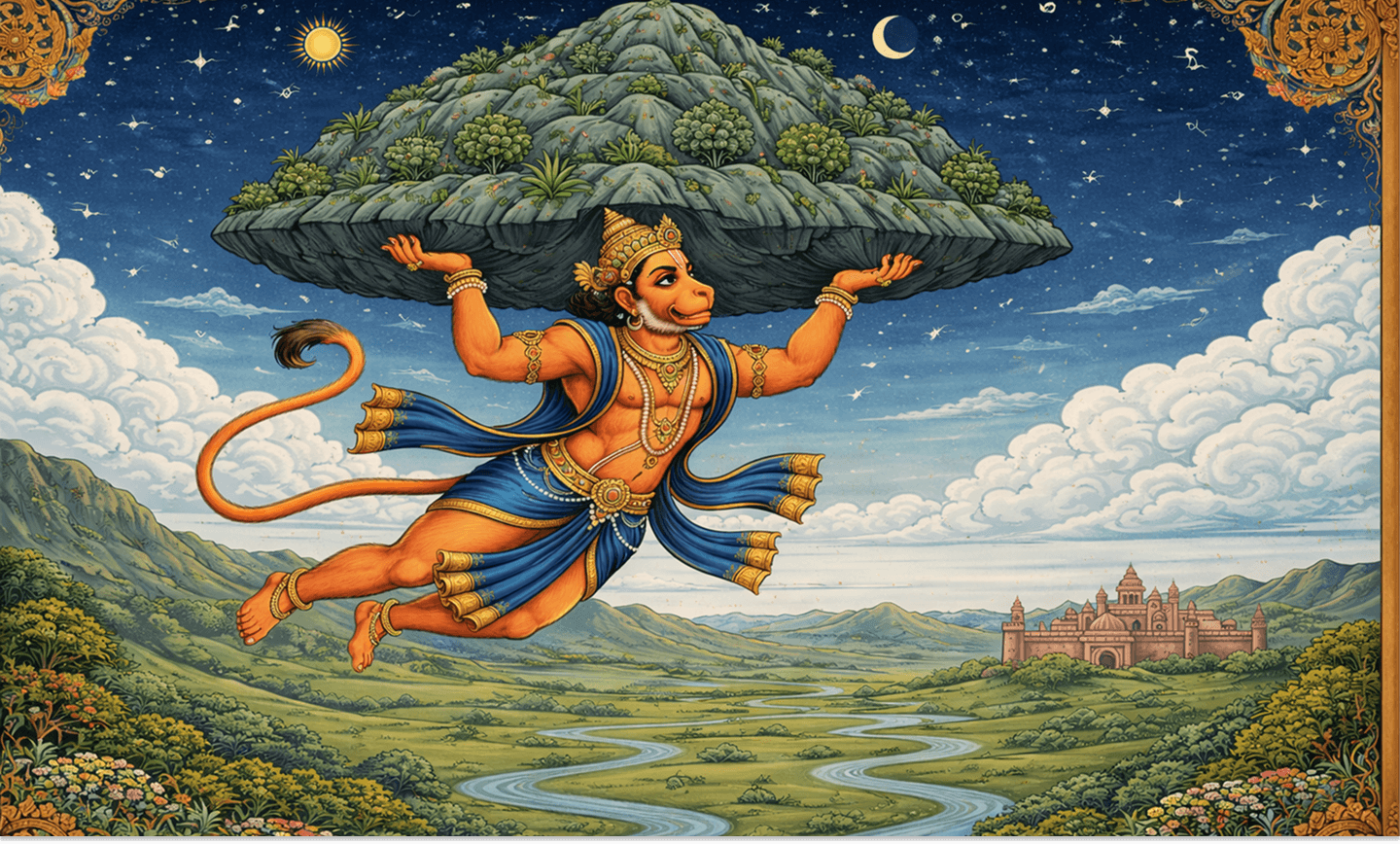

In local tradition, one myth towers above all others in explaining the sacred power of the Gandhamardan Hills. During the Ramayana war, when Lakshmana lay unconscious, Hanuman flew to the Himalayas to retrieve life-saving herbs. As he carried the mountain of medicinal plants back toward Sri Lanka, a fragment slipped from his grasp and fell upon this very region. That fallen piece, according to enduring belief, became the Gandhamardan range itself.
Because of this mythic descent from the Himalaya, the hill is thought to contain a natural abundance of potent herbs—Sanjeevani among them. This idea is reinforced not only by legend but by the observable botanical richness of the forests, long known to local healers and tribal communities. Generations of traditional practitioners have gathered roots, leaves, and barks from these slopes, sustaining the belief that the hill preserves echoes of Himalayan medicinal power.
The “Sanjeevani origin” narrative is so embedded in regional consciousness that it becomes especially prominent during the Baisakh Mela and in healing pilgrimages, where devotees invoke the myth to seek physical renewal, spiritual wellbeing, and blessings from the sacred landscape itself.
Wherever divine purpose touches the earth, healing takes root in silence.
The botanical richness observed today reinforces the legend. Tribal communities have long relied on these slopes for medicine, preserving a lineage of knowledge that dates back centuries.