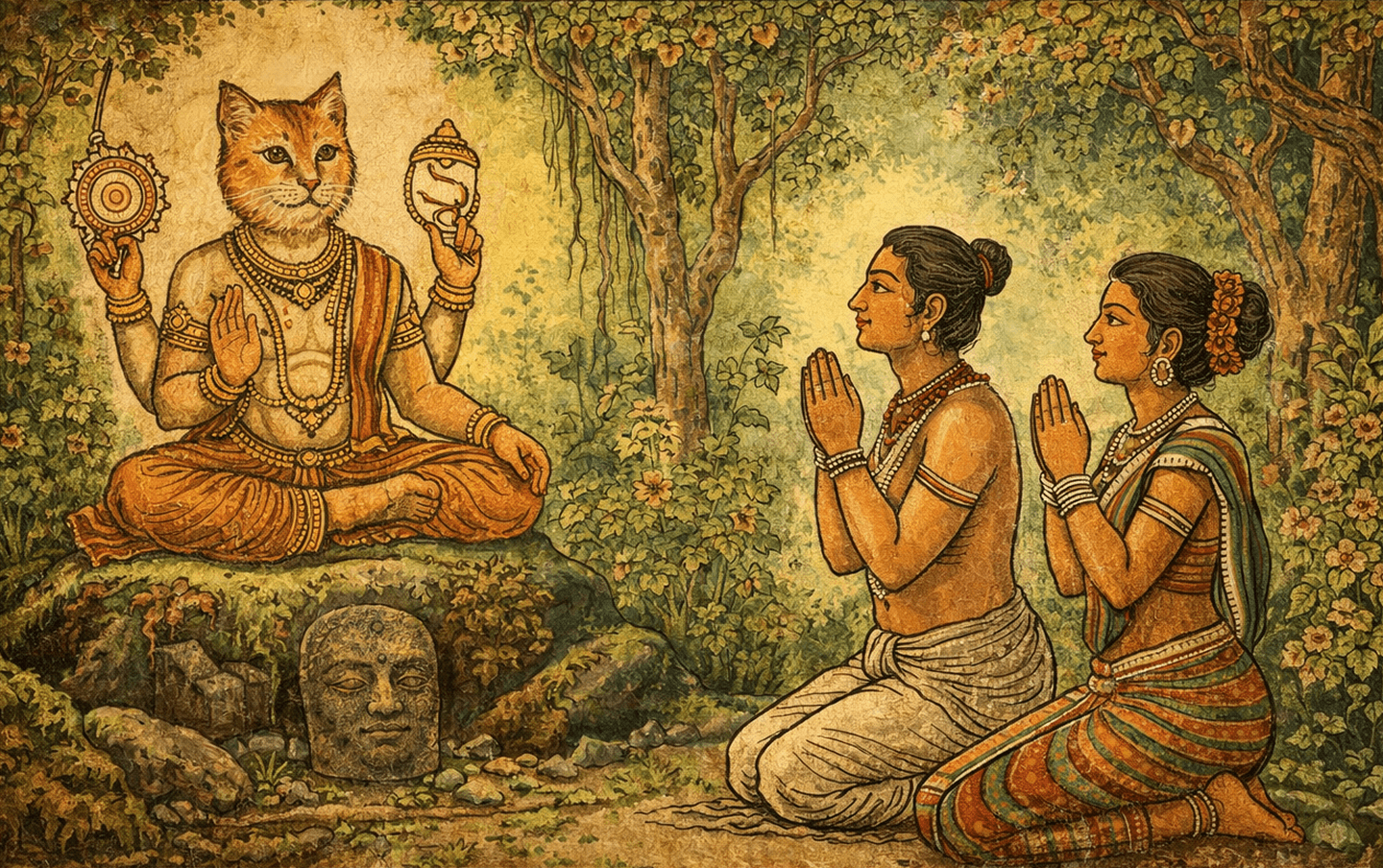

According to cherished local tradition, the beginnings of the temple are rooted in the lives of a humble Kondh tribal couple, Hari and Yamuna—ordinary hill-dwellers who became custodians of an extraordinary divine discovery.
One day, as Yamuna was digging on the slopes of the Gandhamardan hill, her spade struck a stone unlike any other. To her terror, the stone began to bleed. Overcome with fear, she dropped her tool and fled home. That night, the mystery deepened. In her dreams, the stone transformed into a radiant divine figure—Lord Marjara-Keshari—who assured her there was nothing to fear. He instructed her to return to the spot, recover the sacred image, and begin worship.
At the same time, far away, King Baijal Dev experienced his own vision in which the deity appeared to him, confirming Yamuna’s revelation. Guided by this divine message, the king journeyed to the site, recognized its sanctity, and supervised the formal installation of the image. Under his patronage, a temple was constructed to honor the manifestation of the Lord on that very spot.
In recognition of their role in discovering the deity, Hari and Yamuna were appointed as the first caretakers. Their descendants retained certain hereditary ritual privileges—most notably the honor of hoisting the temple flag during the Baisakh festival—a tradition that continues today. Although daily priestly duties gradually shifted to Brahmin priests over time, the Kondh lineage remains symbolically and spiritually woven into the temple’s identity.
This story highlights a unique and profound truth: the temple stands not only as a center of mainstream Hindu devotion but also as a sacred meeting point between tribal faith traditions and classical worship practices. It is this fusion—of hill, forest, deity, and people—that gives the temple its enduring cultural depth and spiritual resonance.
Wherever divine purpose touches the earth, healing takes root in silence.
The botanical richness observed today reinforces the legend. Tribal communities have long relied on these slopes for medicine, preserving a lineage of knowledge that dates back centuries.